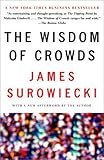
 Onto the next book in our reading series- "Wisdom of Crowds," written by James Surowiecki and first published in 2004. Before enrolling in Beyond iCelebrities and glancing at the syllabus, I had never heard of "Wisdom of Crowds," and honestly would have never read it if it weren't assigned. However, judging by our past book by Malcolm Gladwell,"The Tipping Point," (which I really enjoyed,) I was excited to delve into "Wisdom," figuring it has to be at least on par with "Tipping."
The basic gist of the book is this: Surowiecki is trying to prove
(using a plethora of examples and discussions) that, simply, groups are better off at making
decisions than one or two people (hence the title- "Wisdom of Crowds,"- in crowds lie wisdom.) Surowiecki does a good job illustrating this point by citing the "Who Wants to be a Millionaire," in his explanations- which in turn gave a better idea of what he was saying. The 'Ask the Audience' portion of the
show, where contestants can ha
ve the entire audience poll a question, is what Surowiecki talks about specifically. Most of the time the audience answers the question correctly, which in turn lies their collective 'wisdom.'"
Other specific examples cited in "Wisdom of Crowds" aide Surowiecki's argument greatly, including the idea of Google- when you search for something, the result is a mass of information which you can then boil down and swift through to find just what you are looking for (i.e. the right answer.)

Something Surowiecki delves into for a good chunk of "Wisdom of Crowds" is the idea of diversity (in fact, he devotes the entire second chapter to this idea.) In large 'crowds,' diversity is an easy thing to find- in a mass of people, there are different ideas/opinions and more generally- different type of people. In a small, like-minded crowd, this is much harder to find- so instead, you'll get a lot of the same ideas/opinions rather than just one. The idea of "groupthink," relates to this as well. The more everyone influences one another, the more like-minded everyone becomes- which has it's pros and cons. Pros, because every can agree- but con's because that like-minded group is inclined to make the same mistakes over and over again.
PART ONE TO BE CONTINUED....


1 comment:
The issues of social norms and social media would be interesting to explore in this context....when I first started using Twitter I thought I'd write fiction, haiku, etc...seemed so perfect for that. Yet most of Twitter is newsfeed and over time my tweets have edged in that direction...so group mind can begin with diversity but sometimes adapting to the given language of the "group" no matter how million scribe vast it might be...
Post a Comment